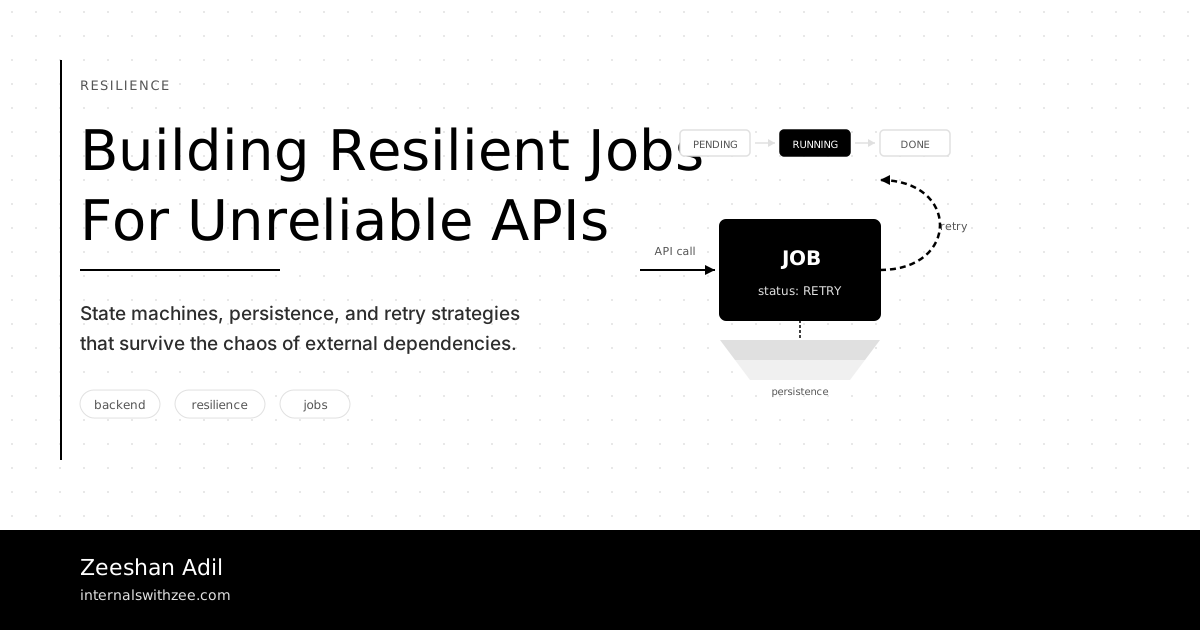
Building Resilient Jobs for Unreliable APIs
State machines, persistence, retries and recovery when the dependencies you call cannot be trusted.
- #resilience
- #background-jobs
- #system-design
- #typescript
- #prisma
We had a queue. A good one. RabbitMQ, properly configured, durable queues, the works. Push a "send email" message, a worker picks it up, calls Microsoft Graph API, done. Textbook stuff.
Except sometimes Microsoft would return a 429. Sometimes our OAuth token expired mid-flight. Sometimes the worker crashed right after sending but before acknowledging the message. And sometimes our RabbitMQ node itself would go down for maintenance.
The queue wasn't the problem. The queue was doing exactly what queues do. The problem was that we were treating an unreliable operation like a reliable one.
Can't queues handle this?
Before I go further, let me address the obvious question: can't you just configure your queue to handle retries, backoff, and rate limiting?
Yes. You can.
RabbitMQ has dead letter exchanges with TTL for delayed retries. BullMQ has built-in exponential backoff. SQS has visibility timeouts and redrive policies. You can implement rate limiting on the consumer side, check circuit breaker state before processing, use separate queues per resource.
So why didn't we?
A few reasons specific to our situation:
We needed to query jobs. "Show me all failed email jobs for this user in the last hour." "How many jobs are stuck on this OAuth connection?" With a database, that's a SQL query. With a queue, messages are opaque until consumed. You'd need to build a separate tracking system.
We needed to modify jobs after enqueueing. Cancel a scheduled email because the user deleted it. Update priority because something became urgent. Change the payload because upstream data changed. With queues, once a message is in, it's in. With a database, it's just an update.
We had very long delays. Some retry scenarios meant waiting days before trying again. Queues with multi-day delays get awkward. A runAt timestamp in a database is trivial.
We wanted one place to look. No separate monitoring for queue depth, no message broker to manage, no RabbitMQ dashboard plus application logs plus database queries to piece together what happened. Everything in one table.
The tradeoff is real. Database polling is slower than queue consumption. At very high throughput, you'd feel it. But for external API integrations, the API itself is usually the bottleneck, not your job processing speed. We weren't trying to process 10,000 jobs per second. We were trying to process a few hundred per minute reliably, with full visibility into what was happening.
If you're doing high-throughput internal microservice communication, use a queue. That's what they're built for. If you're integrating with external APIs where you need observability, modifiability, and long delays, a database-backed approach might be simpler.
Now, here's how we built it.
The database is your friend
Instead of treating jobs as ephemeral messages that exist only in transit, we persist them. Every job becomes a row in a table with a status, an attempt count, a scheduled execution time, and a resourceKey that identifies which external resource it's talking to.
model ResilientJob {
  id           String    @id @default(uuid())
  type         String    // 'send-email', 'sync-data', whatever
  resourceKey  String    // The specific API account/connection this job uses
  payload      Json

  status       JobStatus @default(PENDING)
  attempts     Int       @default(0)
  maxAttempts  Int       @default(3)
  runAt        DateTime  @default(now())
  lockedAt     DateTime? // When a worker claimed this job
  errorMessage String?
  createdAt    DateTime  @default(now())

  @@index([status, runAt])
}
That resourceKey field is doing more work than it looks. It's the key to everything that follows.
When you're sending emails through someone's connected Outlook account, you're not just hitting "Microsoft's API". You're hitting it through a specific OAuth connection with its own rate limits, its own token expiry, its own health. If User A's connection is broken, that shouldn't block User B's emails. If one API endpoint is rate-limited, jobs targeting other endpoints should keep flowing.
We track the health of each resource separately:
model ResourceRateLimit {
  resourceKey         String    @id
  nextAvailableAt     DateTime  @default(now())
  consecutiveFailures Int       @default(0)
  lastErrorAt         DateTime?
}
This gives us per-resource rate limiting and per-resource circuit breaking. The granularity matters.
The processing loop
The main processing loop runs on a simple cron. Every few seconds, it wakes up and looks for work. The interesting bits are in how it decides what to do.
const LOCK_TIMEOUT_MS = 5 * 60 * 1000; // 5 minutes
const MAX_ATTEMPTS = 3;

while (true) {
  const now = new Date();
  const staleThreshold = new Date(now.getTime() - LOCK_TIMEOUT_MS);

  // Find the next job that's ready to run
  const job = await db.resilientJob.findFirst({
    where: {
      OR: [
        // Ready to run
        {
          runAt: { lte: now },
          status: { in: ['PENDING', 'FAILED'] },
          attempts: { lt: MAX_ATTEMPTS }
        },
        // Stale lock - worker probably crashed
        {
          status: 'RUNNING',
          lockedAt: { lt: staleThreshold }
        }
      ]
    },
    orderBy: { runAt: 'asc' }
  });

  if (!job) break;

  // Optimistic lock - try to claim this job
  const claimed = await db.resilientJob.updateMany({
    where: { id: job.id, status: job.status },
    data: { status: 'RUNNING', lockedAt: now }
  });

  if (claimed.count === 0) continue; // Someone else got it

  // Check if this resource is healthy before we even try
  const healthy = await checkResourceHealth(job.resourceKey);
  if (!healthy) {
    await deferJob(job.id, getCircuitBreakerDelay());
    continue;
  }

  try {
    await executeJob(job);
    await markComplete(job);
    await resetResourceHealth(job.resourceKey);
  } catch (error) {
    await handleFailure(job, error);
  }
}
The lockedAt timestamp handles a failure mode that's easy to miss: what if a worker crashes mid-execution? Without it, the job stays in RUNNING forever. With it, we can reclaim jobs where the lock has gone stale. If a job has been RUNNING for more than 5 minutes, something probably went wrong and another worker can pick it up.
Getting backoff right
The naive approach to retry is exponential backoff. Wait 1 second, then 2, then 4, then 8. It's fine. It's also insufficient for real-world API integrations.
Different failures need different responses. A 500 error probably means "try again soon, the server is having a moment." A 429 means "you're going too fast, here's exactly how long to wait." A 401 means "your credentials are wrong", but in OAuth land, that might just mean your token expired and you need to refresh it.
function computeBackoff(error: any, attempt: number): number {
  const status = error.response?.status;
  const headers = error.response?.headers;

  // If they told us exactly when to retry, listen to them
  if (status === 429) {
    const retryAfter = parseRetryAfterHeader(headers);
    if (retryAfter) {
      return retryAfter * 1000 * 1.2; // Add 20% buffer
    }
  }

  // Standard exponential backoff with jitter
  const base = Math.min(2 ** (attempt - 1), 60);
  const jitter = 0.8 + Math.random() * 0.4;
  return base * 1000 * jitter;
}
That jitter isn't optional. Without it, if you have 50 jobs that all failed at the same moment, they'll all retry at the same moment, fail again, and retry together again.
The Retry-After header parsing is also worth getting right. Microsoft's Graph API uses it. So does Google. When they tell you to wait 47 seconds, they mean it. Ignoring it and hammering them again in 4 seconds just gets you blocked faster.
function parseRetryAfterHeader(headers: Record<string, string>): number | null {
  // Standard header (seconds or HTTP date)
  const retryAfter = headers['retry-after'];
  if (retryAfter) {
    const seconds = Number(retryAfter);
    if (!isNaN(seconds)) return seconds;

    const date = Date.parse(retryAfter);
    if (!isNaN(date)) return Math.max(0, (date - Date.now()) / 1000);
  }

  // Microsoft-specific (milliseconds)
  const msHeader = headers['x-ms-retry-after-ms'];
  if (msHeader) {
    const ms = Number(msHeader);
    if (!isNaN(ms)) return ms / 1000;
  }

  return null;
}
Circuit breakers
The circuit breaker pattern gets talked about a lot but implemented poorly almost as often.
The idea is simple: if a resource keeps failing, stop trying for a while. Don't burn through your retry budget, don't spam a broken endpoint, don't waste everyone's time.
async function checkResourceHealth(resourceKey: string): Promise<boolean> {
  const limit = await db.resourceRateLimit.findUnique({
    where: { resourceKey }
  });

  if (!limit) return true;

  // Circuit breaker: too many consecutive failures
  if (limit.consecutiveFailures >= FAILURE_THRESHOLD) {
    if (limit.nextAvailableAt > new Date()) {
      return false; // Circuit is open, don't even try
    }
    // Circuit half-open: allow one attempt to test
  }

  // Rate limiting: respect the cooldown
  return limit.nextAvailableAt <= new Date();
}
When a job fails, we increment the consecutive failure count. When it succeeds, we reset it to zero. Once failures hit a threshold (we used 3), the circuit opens and all jobs for that resource get automatically deferred by a longer period (we used 5 minutes).
This protects you and the API provider. If someone's OAuth connection is broken, you're not going to fix it by retrying every 10 seconds. You're just going to rack up rate limit violations and make your logs unreadable.
Handling 401s in OAuth land
There's one failure mode that deserves special handling: the 401.
In most contexts, a 401 Unauthorized means "you don't have permission, go away." In OAuth contexts, it often just means "your access token expired." And if you have a refresh token, you can fix it.
async function executeEmailJob(payload: EmailPayload): Promise<void> {
  const account = await db.getAccount(payload.accountId);

  try {
    await emailProvider.send(account.accessToken, payload.email);
  } catch (error) {
    if (error.response?.status === 401) {
      // Token expired - try to refresh
      const newTokens = await emailProvider.refreshToken(account.refreshToken);

      // Persist new tokens for future jobs
      await db.updateAccountTokens(account.id, newTokens);

      // Retry immediately with fresh token
      await emailProvider.send(newTokens.accessToken, payload.email);
      return;
    }

    throw error;
  }
}
This is self-healing code. The token expired, we fixed it, the job succeeded, the user never knew anything was wrong. This is the kind of resilience that actually matters. Not just "we'll try again later" but "we'll try to solve the problem right now."
Making other infrastructure reliable
One pattern that emerged later was using this system to make other infrastructure more reliable.
We use RabbitMQ for event broadcasting. When an email comes in, we publish an event so other services can react. But RabbitMQ can go down. Network partitions happen. What do you do?
You don't publish directly. You write the event to your database in the same transaction as your business logic, then create a resilient job to publish it.
async function handleIncomingEmail(email: Email): Promise<void> {
  // Both operations in same transaction
  await db.$transaction(async (tx) => {
    // 1. Save to database (source of truth)
    const saved = await tx.receivedEmail.create({ data: email });

    // 2. Create a job to publish to RabbitMQ
    await tx.resilientJob.create({
      data: {
        type: 'publish-email-event',
        resourceKey: 'rabbitmq-main',
        payload: { emailId: saved.id }
      }
    });
  });
}

// The job processor:
async function publishEmailEvent(payload: { emailId: string }): Promise<void> {
  const email = await db.receivedEmail.findUnique({
    where: { id: payload.emailId }
  });

  // Idempotency check
  if (email.isPublished) return;

  await rabbitMQ.publish('email-events', transformToEvent(email));

  await db.receivedEmail.update({
    where: { id: email.id },
    data: { isPublished: true }
  });
}
If RabbitMQ is down, the job fails and retries later. If the job succeeds but we crash before updating the database, the idempotency check prevents duplicate publishes. The email is never lost.
When to use what
Queues are optimized for throughput. They want to move messages as fast as possible. That's good for many use cases. But when you're dealing with external APIs that have their own opinions about how fast you should go, throughput isn't the goal. Reliability is.
A database-backed job system is slower than a pure message queue. You're writing to disk, you're polling, you're doing SQL queries. But you gain observability (you can query your jobs), durability (nothing is lost), modifiability (you can change jobs after creation), and intelligence (you can make decisions based on history).
Use queues when:
- High throughput internal communication
- Simple fire-and-forget messages
- You don't need to query or modify messages after enqueueing
- You have existing queue infrastructure and expertise
Consider database-backed jobs when:
- External API integrations with rate limits and auth flows
- You need to query job status, history, and failures
- You need to cancel or modify jobs after creation
- Long delays (hours, days) between attempts
- Observability is more important than raw speed
After we deployed this, the difference was obvious. Jobs that failed were automatically retried with appropriate backoff. OAuth tokens that expired overnight were refreshed transparently. When a user's connection had a persistent issue, the circuit breaker opened, their jobs were deferred, and there was a clean log entry explaining exactly what was wrong.
It wasn't magic. It was just software that remembered what happened and made reasonable decisions about what to do next.
That's all resilience really is.
Sources and further reading
The primary material behind the patterns above, and the pieces worth reading in full.
- Exponential backoff and jitter from the AWS Architecture Blog. The post that made jitter standard practice, with the simulation showing why plain exponential backoff still synchronises clients.
- Timeouts, retries and backoff with jitter in the Amazon Builders' Library. The operational version of the same argument: retry budgets, when a retry makes an outage worse, and why every retry needs a timeout above it.
- Circuit breaker by Martin Fowler. The canonical description of the three states and what each one is for. The idea originates in Michael Nygard's Release It!, which is worth the whole book.
- Addressing cascading failures and Handling overload from the Google SRE book. What actually happens when a dependency degrades and everyone retries into it, written by people who watched it happen at scale.
- Timeouts, retries, and idempotency by Marc Brooker. Short, precise, and the clearest explanation of why retries are only safe when the operation is idempotent.
- Transactional outbox on microservices.io. The pattern for making a database write and the message announcing it atomic, which is the gap this article's job table closes by hand.
- Stripe: idempotent requests. A production API's idempotency key design, and a good model to copy when you own the endpoint being retried.
- RFC 6749, the OAuth 2.0 framework. Section 6 covers refresh tokens, which is the specification behind the 401 handling above.
Continue learning
If the job table now makes sense, the next thing worth understanding is delivery semantics: at-least-once, at-most-once and what exactly-once really means in practice, because it decides how hard your idempotency has to work. After that, the outbox pattern, which is the same problem one layer down at the database boundary. Then queue internals, visibility timeouts and dead letter handling, so you can tell when a broker would have been the simpler answer after all.
FAQ
Should I always use a database instead of a queue? No. This design suits jobs that are long-lived, queryable, modifiable after enqueue, or delayed by days. For high-throughput fire-and-forget work, a broker is simpler and faster.
How do I pick the maximum retry count? From the failure you are retrying. A rate limit resolves in seconds to minutes, so a handful of retries with backoff is right. A broken credential will never resolve on its own, so retrying it at all is wasted work. Classify the error first, then choose.
Does a circuit breaker need to be shared across workers? If the resource is shared, yes, otherwise each worker discovers the outage independently and the breaker barely helps. Keeping breaker state in the database, next to the jobs, is the simplest way to share it.